El "present continuous" de cualquier verbo se compone de dos partes: el presente del verbo to be + el "present participle" del verbo principal.
(Para formar el "present participle": raíz+ing, e.g. talking, playing, moving, smiling)
Afirmativa
Sujeto
+ to be
+ raíz + ing
She
is
talking.
Negativa
Sujeto
+ to be + not
+ raíz + ing
She
is not (isn't)
talking
Interrogativa
to be
+ sujeto
+ raíz + ing
Is
she
talking?
EJEMPLOS: TO GO, "PRESENT CONTINUOUS"
Afirmativa
Negativa
Interrogativa
I am going
I am not going
Am I going?
You are going
You aren't going.
Are you going?
He, she, it is going
He, she, it isn't going
Is he, she, it going?
We are going
We aren't going
Are we going?
You are going
You aren't going
Are you going?
They are going
They aren't going
Are they going?
Nota: contracciones de las formas negativas: I'm not going, you're not going, he's not going etc.
FUNCIONES DEL "PRESENT CONTINUOUS"
Como ocurre con todos los tiempos verbales del inglés, la actitud del hablante es tan importante como el momento en que ocurre la acción o el evento. Al emplear el "present continuous", nos estamos refiriendo a algo que no ha terminado o está incompleto
EL "PRESENT CONTINUOUS" SE UTILIZA:
para describir una acción que está teniendo lugar en este momento: You are using the Internet. You are studying English grammar.
para describir una tendencia o una acción que está sucediendo en la actualidad: Are you still working for the same company? More and more people are becoming vegetarian.
para describir una acción o evento futuros que ya están programados: We're going on holiday tomorrow. I'm meeting my boyfriend tonight. Are they visiting you next winter?
para describir una situación o evento temporales: He usually plays the drums, but he's playing bass guitar tonight. The weather forecast was good, but it's raining at the moment.
con "always, forever, constantly", para describir y enfatizar una sucesión de acciones repetidas: Harry and Sally are always arguing! You're constantly complaining about your mother-in-law!
¡CUIDADO! Hay algunos verbos que no suelen emplear la forma progresiva
VERBOS QUE NO SUELEN EMPLEAR LA FORMA PROGRESIVA
Los verbos de la siguiente lista suelen utilizar la forma simple porque hacen referencia a estados, más que acciones o procesos.
Los verbos de sensación y percepción (see, hear, feel, taste, smell) suelen utilizarse con can: I can see... Pueden tomar la forma progresiva pero, en este caso, su significado suele variar.
This coat feels nice and warm. (percepción de las cualidades del abrigo)
John's feeling much better now (está mejor de salud)
She has three dogs and a cat. (posesión)
She's having supper. (está tomando)
I can see Anthony in the garden (percepción)
I'm seeing Anthony later (tenemos intención de vernos)
Normally in the present tense we add S to the end of the verb in the 3rd person (He, She, It).
Verb
3rd Person
Speak
Speaks
Play
Plays
Give
Gives
Make
Makes
He speaks three languages.
She drinks coffee every morning.
My dog hates my cat.
Irregular Verbs
Irregular verbs in English in the present tense follow very simple rules. The only change that is made to these verbs is in the third person – for He, She or It.
1. If the verb ends in SS, X, CH, SH or the letter O, we add + ES in the third person.
Verb
3rd Person
Kiss
Kisses
Fix
Fixes
Watch
Watches
Crash
Crashes
Go
Goes
A mechanic fixes cars.
She watches soap operas every afternoon.
He kisses his wife before he goes to work.
2. If the verb ends in a Consonant + Y, we remove the Y and + IES in the third person.
Verb
3rd Person
Carry
Carries
Hurry
Hurries
Study
Studies
Deny
Denies
Isabel studies every night.
The baby cries all the time.
He denies all responsibility.
Negative Sentence
To form the negative we use the auxiliary do not. Again, the only variation occurs in the 3rd person where we use does not.
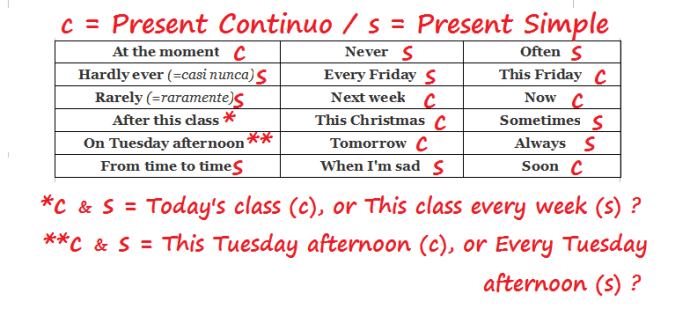
Adverbs of frequency tell us how often something happens, and they can be either definiteor indefinite. Because we are talking about repeated or habitual activities, adverbs of frequency are usually only used with the Present Simple tense.
Some examples of definite adverbs of frequency:
Hourly, daily, weekly, monthly, yearly.
Every minute, once an hour, quarterly.
Once, twice, three times, a million times.
Definite adverbs of frequency usually go at the end of the sentence, like most definite time expressions.
Most businesses submit their taxes quarterly.
He checks his watch every minute.
The bell rings every hour.
We can also put the adverb at the beginning of the sentence for strong emphasis:
Every night, we stay up late to study.
Twice a year, she goes to Chile.
Every year, thousands of people are misdiagnosed.
.
Some examples of indefinite adverbs of frequency, and a general idea of how often the action takes place: